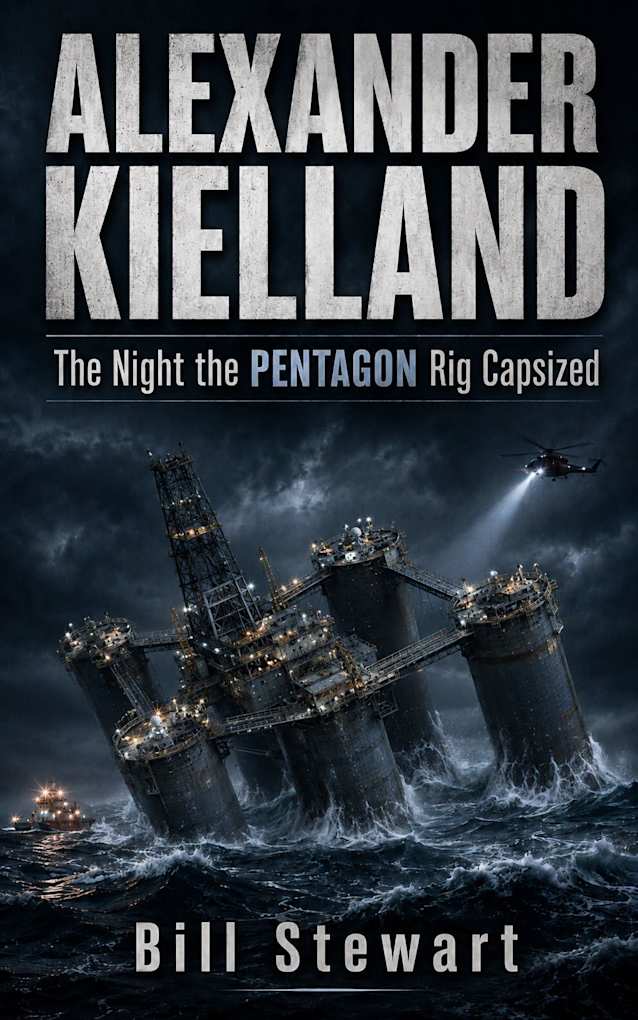
ALEXANDER L KIELLAND: The Night a Pentagon Rig Capsised
About
On 27 March 1980, the North Sea turned one of Europe’s most recognisable offshore platforms into a death trap.
Alexander L. Kielland was a five-column PENTAGON-class semi-submersible being used as an accommodation platform in Norway’s Ekofisk field. There were 212 men aboard.
Within little more than twenty minutes, the platform had capsized.
123 men died. Only 89 survived.
The catastrophe began with something almost impossibly small compared with the structure it destroyed: a fatigue crack developing around a welded hydrophone support on structural brace D-6.
When that brace finally failed, the surrounding structure could not contain the damage. Further braces failed. One of the platform’s five columns tore away. Stability disappeared. Lifeboats became increasingly impossible to launch as the rig heeled, and men were forced into the freezing North Sea.
But the Alexander L. Kielland disaster is about far more than one cracked brace.
In this detailed investigation, Bill Stewart examines:
- the distinctive five-column PENTAGON design;
- the fabrication defect that allowed fatigue cracking to develop;
- why inspections failed to find the growing crack;
- how a local structural failure became progressive collapse;
- the desperate attempt to abandon the platform;
- lifeboat and liferaft failures under severe heel;
- the rescue operation in darkness and heavy seas;
- the official Norwegian investigation;
- the question of responsibility;
- the experience of survivors and bereaved families;
- the offshore safety reforms that followed;
- and why Norway returned to the Kielland case decades later.
Drawing upon more than twenty-five years of experience in the oil and gas industry, Stewart examines both the engineering and the human consequences without sensationalism and without losing sight of the 123 men who never came home.
Alexander L. Kielland is the story of a hidden defect, a catastrophic failure chain, and an offshore industry forced to learn one of its hardest lessons.
Because the most dangerous failure is often the one nobody can yet see.