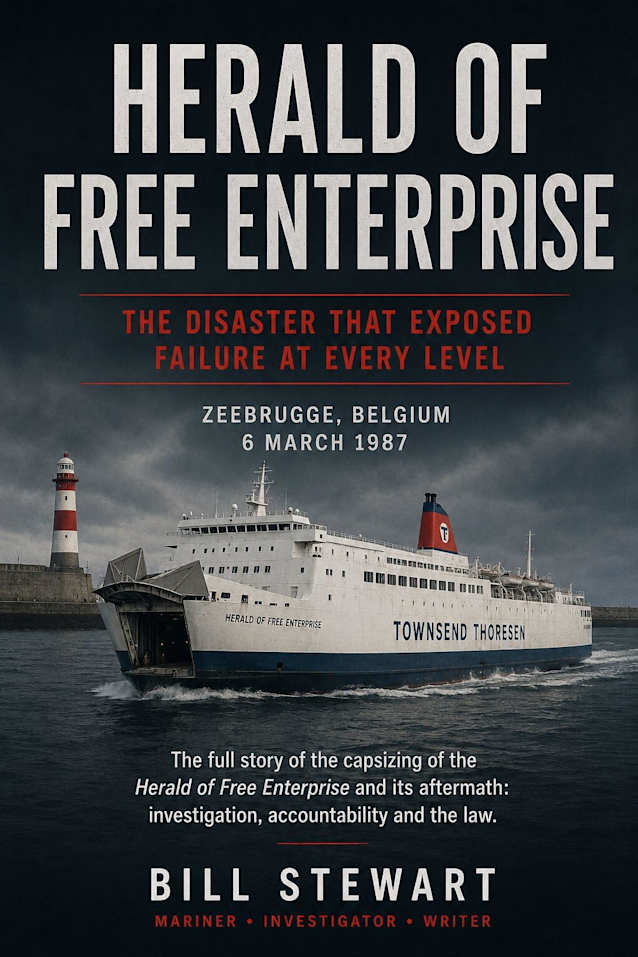
Herald of Free Enterprise: The Disaster that Exposwd Failure at Every Level
About
On 6 March 1987, the roll-on/roll-off passenger ferry Herald of Free Enterprise sailed from Zeebrugge for Dover.
Her bow doors were still open.
Within minutes, seawater was pouring across the vehicle deck. The ferry lost stability and capsized onto her port side in shallow water.
One hundred and ninety-three people died.
The immediate cause appeared brutally simple. A crew member responsible for closing the bow doors was asleep. The doors remained open. The ship sailed.
But that was only the beginning of the story.
The official investigation uncovered failures reaching far beyond one sleeping crewman. The Chief Officer had not positively verified that the doors were closed. The Master could not see them from the bridge. No indicator showed their status. Previous concerns had been raised. Management systems depended heavily upon assumption rather than positive confirmation.
Mr Justice Barry Sheen’s Formal Investigation delivered one of the most devastating assessments ever made of a British shipping company, describing a “disease of sloppiness” extending through the organisation.
Then came an even more troubling question.
If corporate failures had contributed to the deaths of 193 people, could the company itself be held criminally responsible?
The subsequent corporate manslaughter prosecution exposed a profound weakness in British law. Investigators could identify a failing organisation, yet prosecutors struggled to identify the single senior individual whose conduct could legally represent the company itself.
In HERALD OF FREE ENTERPRISE — The Disaster That Exposed Failure at Every Level, former mariner and marine accident investigator Bill Stewart examines the casualty from the shipboard failures that began the disaster to the management culture, inquiry, criminal proceedings and legal reforms that followed.
This is not simply the story of a ferry that sailed with her bow doors open.
It is the story of what happens when responsibility exists at every level — but certainty exists at none.