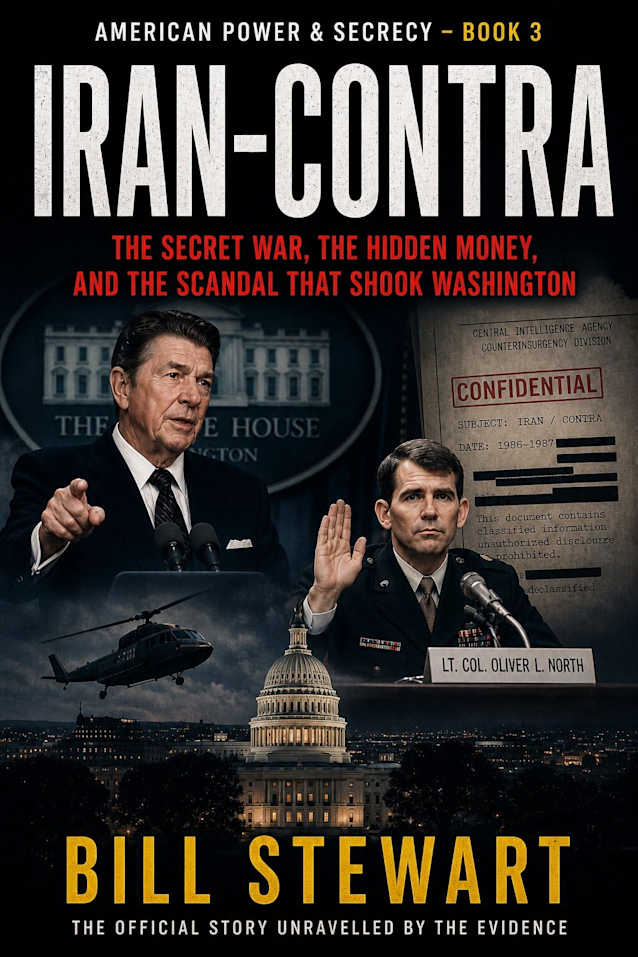
IRAN - CONTRA: The Secret War, The Hidden Money, and The Scandal that Shook Washington DC (American Power and Secrecy Book 3)
About
In the closing years of the Cold War, the United States government found itself navigating a series of conflicts that did not fit neatly into declared wars or openly debated policy. These were operations conducted in the margins—between diplomacy and force, between law and expediency—where decisions were made quickly and often without full public scrutiny.
By the mid-1980s, two separate geopolitical challenges were pressing on the Reagan administration.
In Central America, the Sandinista government in Nicaragua had taken power, replacing a regime long supported by Washington. The new leadership aligned itself with socialist principles and maintained ties with Cuba and the Soviet Union. For policymakers in the United States, this shift was viewed not simply as a regional political change, but as part of a broader strategic contest.
At the same time, in the Middle East, American citizens were being held hostage by groups linked to shifting factions within Lebanon. These hostage situations placed additional pressure on decision-makers in Washington, where public statements and private actions did not always align.
Officially, United States policy was clear.
Congress had passed legislation—most notably the Boland Amendments—restricting direct or indirect military support to the Nicaraguan Contra forces. These measures were intended to ensure that the executive branch did not expand the conflict without legislative oversight.
Equally clear was the stated position of the United States government on negotiating with those connected to hostage-taking. Publicly, the policy was firm: there would be no concessions, no exchanges, and no encouragement of further abductions.
Yet beneath these official positions, a different set of decisions began to take shape