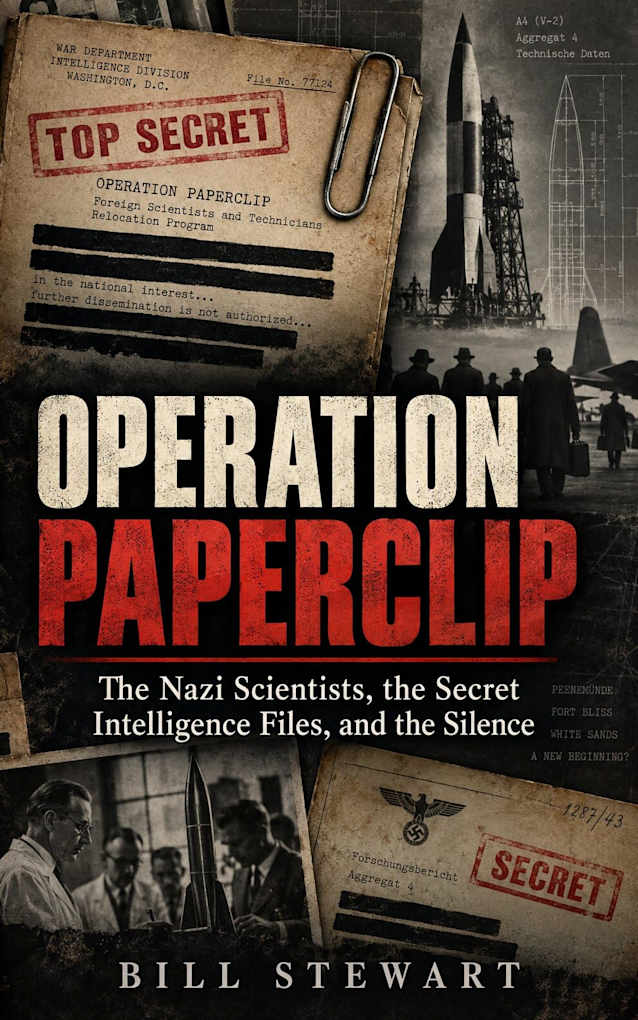
Operation Paperclip: The Nazi Scientists, the Secret Intelligence Files, and the Silence
About
In the ruins of Nazi Germany, another war had already begun.
American and Soviet intelligence teams were racing to seize the scientists, engineers and technical knowledge left behind by the Third Reich. Rocket specialists. Aviation experts. Doctors. Engineers. Men whose knowledge could shape the next generation of weapons.
The United States called its programme Operation Paperclip.
The official purpose was clear: secure German expertise before the Soviet Union could.
The problem was what American investigators began finding in the files.
Nazi Party membership.
SS connections.
Links to forced labour.
Contradictory testimony.
Questions about what certain scientists had known — and what they had chosen not to say.
As US Army Counterintelligence officers examined the backgrounds of the men America wanted, an uncomfortable conflict emerged. Security investigators were asking whether some candidates should be admitted at all. Military and scientific sponsors were asking whether the United States could afford to lose them.
Then the Cold War changed the calculation.
In Operation Paperclip: The Nazi Scientists, the Secret Intelligence Files, and the Silence, Bill Stewart follows the programme from the collapse of the Third Reich through Peenemünde, Mittelwerk and Mittelbau-Dora, into Fort Bliss, White Sands, Redstone and ultimately the American space programme.
At the centre are the men whose later achievements became part of American history — including Wernher von Braun, Arthur Rudolph and Hubertus Strughold — and the intelligence files that told a far more complicated story.
This is not a claim that every scientist recruited through Paperclip was a war criminal.
Nor is it a conspiracy story.
It is an investigation into something more unsettling:
What happens when intelligence uncovers truths that national policy finds inconvenient?
Operation Paperclip strengthened American science.
It accelerated missile development.
It helped shape the space age.
And it left behind files showing how strategic necessity, bureaucracy and ambition could quietly move moral boundaries.
The rockets became famous.
The scientists became heroes.
The files waited.