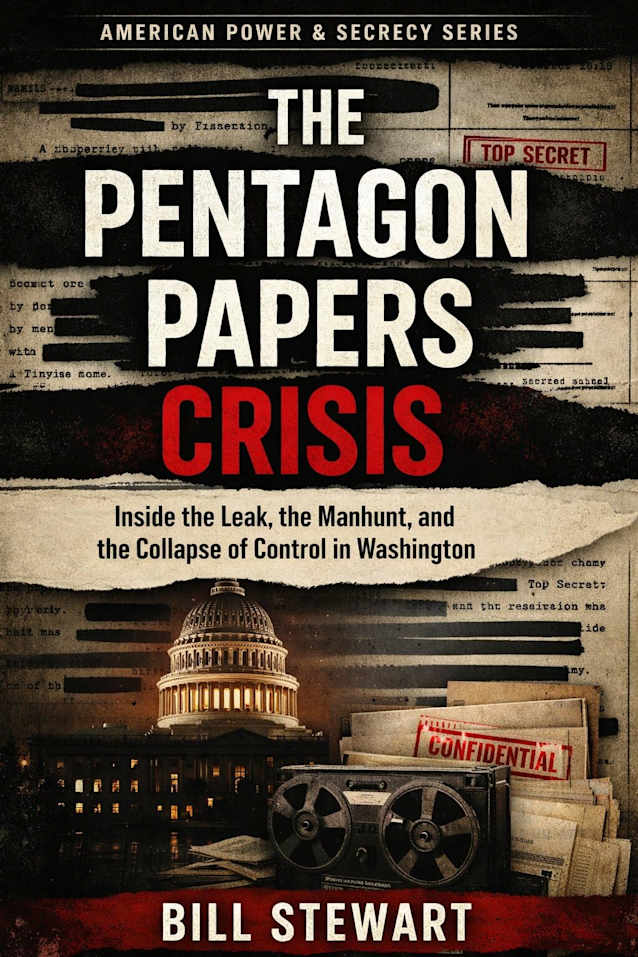
The Pentagon Papers Crisis: Inside the Leak, the manhunt, and the collapse of control in Washington (American Power and Secrecy Book 1)
About
Washington, D.C.
June 1971
The system did not fail quietly.
It did not fracture in some distant corridor or obscure archive. It broke at the very centre of power, where classified truth was meant to remain contained, controlled, and unquestioned. When the first instalments of what would become known as the Pentagon Papers leak appeared in print, the breach was not simply informational.
It was structural.
The United States government had lost control of its own secrets.
Inside the White House, the reaction was immediate and visceral. Trust, once assumed as a prerequisite of clearance, became a liability overnight. The pool of those who could have accessed the documents was already small. The pool of those who would risk releasing them was believed to be smaller still.
That assumption would not hold.
Suspicion does not expand under pressure. It contracts.
Within hours, attention turned inward. Analysts reviewed access logs. Departments revisited clearance structures. Long-standing assumptions about loyalty were quietly set aside. The machinery of internal security, built to defend against foreign adversaries, now reoriented itself toward a far more uncomfortable possibility.
The adversary might already be inside.
At the centre of this developing storm stood Daniel Ellsberg, a former military analyst with extensive access to classified Vietnam War material. But in the early hours of the crisis, his name was not yet fixed in place. It existed within a narrowing field of possibility.
And every name carried consequence.
The pressure intensified at the highest level. Richard Nixon viewed the leak not merely as a breach of protocol, but as a direct challenge to executive authority. The release of classified historical analysis did more than expose past decisions—it risked destabilising present control.
The response would not be measured.
Within the Federal Bureau of Investigation, under the long-standing leadership of J. Edgar Hoover, the shift was immediate. The Bureau had spent decades refining its approach to external threats. Now it was required to apply those same methods within a closed system built on hierarchy, clearance, and presumed loyalty.
The tools remained unchanged.
The target did not.
Files were opened. Surveillance authorities were tested. Boundaries that had once separated lawful investigation from executive pressure began to blur. As the search tightened, the cost of suspicion spread outward, touching individuals who had not yet been accused, but could no longer be trusted.
The system was no longer searching for truth.
It was searching for certainty.
And certainty, under pressure, is rarely neutral.
What followed would not remain contained within a single investigation. The hunt for the source of the leak would bleed into broader actions, some of which would later surface during the unfolding of the Watergate scandal, drawing a direct line between internal paranoia and external misconduct.
The breach did not end with identification.
It changed how power behaved.
This is not the story of a document leak.
This is the story of what happens when a system designed to guard secrets begins to suspect itself.