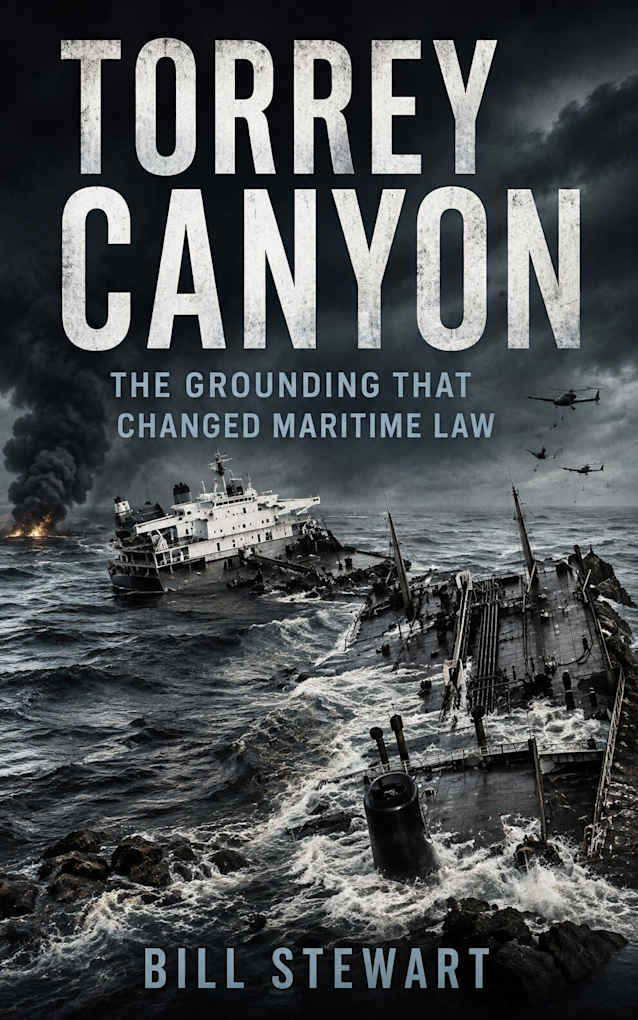
TORREY CANYON: The Supertanker Disaster That Changed Maritime Law and The Fight Against Oil Pollution.
About
On the morning of 18 March 1967, the supertanker Torrey Canyon was approaching the western entrance to the English Channel carrying around 120,000 tonnes of crude oil.
The Seven Stones reef was charted.
The weather had not made the passage impossible.
The ship remained operational.
Yet within minutes, one of the largest tankers then afloat would be stranded on granite between Cornwall and the Isles of Scilly.
What followed changed maritime history.
As the damaged tanker broke apart, crude oil spread across the Atlantic towards the Cornish coast, the Channel Islands and France. Salvors fought to save the ship. One would lose his life. Britain struggled to contain a pollution disaster on a scale it had never faced before.
Then came an extraordinary decision.
The British Government sent military aircraft to bomb the wreck.
Explosives, rockets and aviation fuel were used in an attempt to burn the remaining oil before still more could reach the coastline.
But destroying the tanker did not end the disaster.
Beaches turned black.
Seabirds died in their thousands.
Vast quantities of powerful detergents were sprayed across contaminated shores — only for scientists to discover that in some places the treatment itself had caused severe ecological damage.
And behind the cleanup waited another problem.
The law was not ready.
Who had the right to intervene against a foreign tanker outside normal territorial jurisdiction?
Who should pay for pollution crossing international boundaries?
What responsibility belonged to the shipowner, the charterer, the insurers and the flag state?
The answers would help reshape international maritime law.
In TORREY CANYON, Bill Stewart reconstructs the disaster from the final approach to the Seven Stones through the grounding, salvage battle, military bombing, environmental catastrophe and legal aftermath.
Drawing the threads together through the principles of marine safety and accident investigation, the book asks the question at the heart of every major disaster:
Where should the chain have been broken?
The answer reaches far beyond one captain and one tanker.
Torrey Canyon exposed a world that had learned how to transport oil on an unprecedented scale before it had learned how to deal with the consequences when that system failed.
The ship was eventually destroyed.
Its legacy was not.