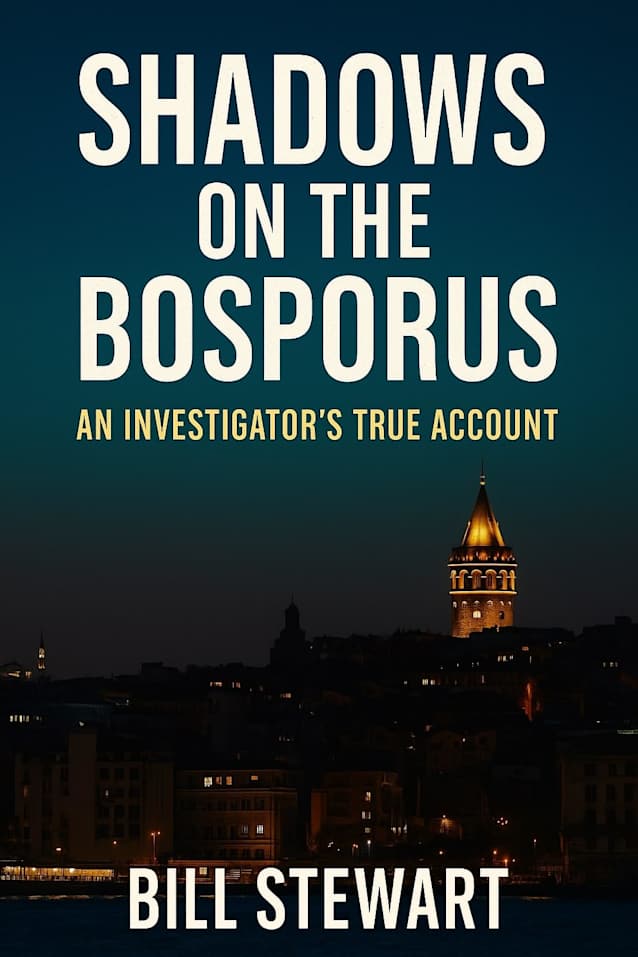
Turkey-Shadows on the Bosporus An Investigators Account
About
They say Istanbul never sleeps, but I’ve learned that some of its dreams run darker than any waking nightmare. The city breathes in layers — the Ottoman ghosts whispering through the mosques, the hum of ferries cutting across the Bosporus, the neon signs of Beyoğlu clinging to memories they no longer own. Once, back in the early seventies, when many still called it Constantinople out of habit or nostalgia, I walked these streets as a young reporter chasing whispers of smuggling rings and missing girls no one dared to write about. Fifty years later, I’ve come back. Not as a bright idealist, but as a man carrying a case that never stopped nagging at me.
The difference between Istanbul then and Istanbul now is a matter of surface. Beneath, it’s the same pulsing city, the same undercurrent of power and silence. Every brick of the old walls feels like it’s keeping a secret. Across the Bosporus, the lights of Anatolia seem to blink like morse code — as if someone’s still trying to get a message through.
It started, as these things usually do, with a name: Leyla K. The letter arrived anonymously, written in a hand that felt deliberate, cautious. It mentioned her disappearance in 1973 — an unresolved case, the mention of “friends in uniform,” and a hint that I’d once known more than I realised. The writer signed off with: “Some debts aren’t paid in money.” It was enough to pull me out of my quiet London apartment and back to a city I had tried to forget.
Over the years, I’d filed hundreds of stories — about syndicates in Naples, political disappearances in Mexico City, shell companies in Macau — but Istanbul was the one that always slipped through my fingers. There is something about Turkey’s dual soul — part West, part East — that mirrors the criminal mind: methodical yet reckless, modern yet ancient. The mafia that thrived here never looked quite the same as in other countries. It was a shapeshifter; one moment a family business, the next a state contractor, the next a protection racket run out of a cafe with a view of the sea.
Walking down Istiklal Avenue now, I can almost hear the seventies — the echo of heels on cobblestones, the faint Arabic melodies from a transistor radio, the laughter that covered too many crimes. But there are new ghosts too: corruption cases swept under marble floors, shipping manifests that don’t match the cargo, names that vanish from police records. Turkey’s modern face wears a smile, but the underworld still lingers beneath the makeup.